
Recently, The Guardian, one of the most prestigious newspapers both in the UK and globally, published an interesting article titled Why are chemical weapons worse than other weapons of mass destruction?
Taking the Syrian war as a reference, the author asks why there is an international agreement for the non-proliferation of chemical weapons, but there is no such agreement for the use of other types of weapons of mass destruction.
The article reviews the evolution of the various international agreements signed during the last two centuries by most of the countries in the international sphere. Starting with the Declaration of St. Petersburg of 1868 to the Rome Statute of the International Criminal Court of 1998 through the Hague Conventions of 1899 and 1907 or the Chemical Weapons Convention of 1993, the author highlights the lack of an explicit list of the so-called Weapons of Mass Destruction that could serve as a reference in the international context and that is sanctioned by a relevant majority of countries.
Taking as a reference the Convention on the Prohibition of the Development, Production, Stockpiling and Use of Chemical Weapons and on their Destruction of 1993, which is administered by the Organization for the Prohibition of Chemical Weapons (OPCW), based in The Hague. It is important to note that this Convention distinguishes 3 types of chemicals that are categorized as Chemical Weapons and therefore must be controlled:
- Tier 1: chemicals that are used primarily for chemical weapons manufacturing and have minimal use outside of chemical weapons manufacturing (sometimes pharmaceutical research or chemical weapons defense systems). Countries must declare an annual production of more than 100 grams, and the maximum storage limit is 1 ton. Examples of these substances are mustard gas or nerve agents.
- Tier 2: Chemicals with licit applications in small-scale quantities. Countries must declare their manufacture and there are restrictions on international trade. An example of this substance is Thiodiglycol, which can be used both for the manufacture of mustard gas and as an ink solvent.
- Tier 3: Chemicals with licit applications with large-scale quantities. Countries must declare their manufacture when more than 30 tons are produced and there are also restrictions on their international trade. Examples of these substances are phosgene (which can be used as a chemical weapon but also as a precursor for organic and inorganic compounds) or Triethanolamine (used in the manufacture of nitrogen mustard, but also used in the manufacture of detergents).


The strength of this convention lies in the fact that so far 192 of the 195 countries recognized by the United Nations have signed and ratified the treaty.
However, neither the signing of the treaty nor the monitoring and control exercised by the OPCW to ensure its implementation and compliance mean that the threat of an incident involving chemical agents has disappeared.
On the one hand, there are the facts established and proven by the OPCW itself of the use of chemical agents (as in the recent case of the Syrian war).
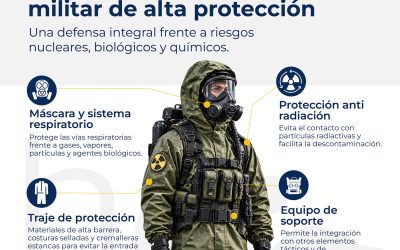
On the other hand, we must bear in mind that Hazmat or NBC incidents can be caused either by a deliberate use of the chemical agent (by a country in the case of a war, but also by a terrorist group) or by an accident.
In other words, although the OPCW and the Chemical Weapons Non-Proliferation Convention can control and reduce Hazmat incidents caused by the use of chemical weapons in a war scenario by one of the opposing countries, the risk of a Hazmat incident caused by a terrorist attack or by an accident (whether industrial or caused by a natural disaster) unfortunately remains.
For this reason, the Defense Programs and Strategies of the countries continue to consider the possibilities and risks of a NBC incident, a High Impact, Low Probability (HILP) event, for which the appropriate management protocols must be developed, including the training and coordination of the different emergency bodies, agencies and units with responsibilities in the management of an incident of this type.


An example of this preparation can be found in the combined joint exercises that the UME organizes annually, and which this year 2018 under the name Region of Murcia 2018 involved a simulation of a catastrophe scenario due to Seismic Risk that would produce derived risks with a predominance of Environmental Risks and Technological Risks NBQ in the for 5 days with the participation of more than 3,500 troops.
Hispano Vema had the privilege of being able to collaborate in the development of this Combined Joint Exercise whose objective is to faithfully reproduce the context of an Emergency and to validate the Contingency Plans of the State Civil Protection Plans for the management of Hazmat or NBC incidents.
In this context, the objective of Minimizing Risks and Saving Lives is paramount, and for this purpose the decontamination of people is a key element, either with decontamination showers integrated in rapidly deployable NBC equipment or with Mass Decontamination Stations for personnel.