We work in robotics, developing a robot dog that transports supplies in hazardous areas and drones for decontamination, and we have developed a fabric that conceals soldiers and vehicles from thermal sensors and night-vision goggles. We all share the same goal: to ensure that no soldier has to put themselves at risk any more than necessary.
Unmanned drones have changed the risks on the ground. With minimal investment, they can disable equipment worth millions of euros, and being detected now poses an enormous risk to units. Protecting people who work in conflict zones is the challenge that has led us to pursue new avenues of innovation at Hispano Vema.
These lines can be summarized in two points: a camouflage fabric that reduces the visibility of units, and robotics designed so that machines—not people—take on the most dangerous tasks.
A fabric that conceals soldiers and vehicles from thermal sensors and night-vision devices
At our facility in Zaragoza, we have developed an innovative fabric capable of camouflaging soldiers, tanks, and logistics vehicles from aerial threats. Its purpose is to render units invisible to:
- Night vision devices
- Temperature Sensors
- Detection systems
It does not affect human vision, but rather the technologies used today to track units, such as those used by many drones. When being detected poses a huge risk, hiding from these systems can make all the difference.
“We are at an advanced stage of development in terms of implementing this solution,” explains José Antonio Navarro, a former military officer and founder of Hispano Vema 23 years ago. We are currently finalizing the certification of the equipment with some of NATO’s leading armed forces, a key step in determining the full scope of its applications.

Robotics to Protect Soldiers: Robot Dogs and Drones
Robotics is the next area we want to focus on, particularly with applications in logistics and in our specialty, NBC protection. We are working on two fronts.
Military robot dog: It carries supplies so a soldier doesn’t have to
We are developing a robot dog capable of transporting supplies in high-risk conflict zones. Its mission is to prevent soldiers from having to cross dangerous areas to transport medicine, equipment, or weapons from one place to another.
The reason is clear. As Rafael Arruga, director of business development at Hispano Vema, explains, the transport of supplies in conflict zones accounts for nearly 85% of the fatalities in a conflict. That is why logistics is one of the areas where robotics can help save more lives: every trip a machine makes is a trip a person does not have to make.
Drones to decontaminate CBRN areas while minimizing the number of people exposed (a path forward)
Our plan is to break into the field of robotics by first applying what we know best: decontamination from nuclear, radiological, and chemical agents. One of the possibilities we are considering is using drones for these tasks. “Decontamination carried out using drones may require fewer personnel and can be done more quickly and effectively than with current procedures,” notes Arruga.
The advantages we see in this line are:
- Fewer people exposed in contaminated areas.
- Faster operations.
- More effective than current procedures.
This is a future product line, not a product that is currently available. With it, we want to build on our experience in NBC and expand it with more agile and secure technology.

From NBC decontamination to camouflage and robotics: this is how we have expanded our operations
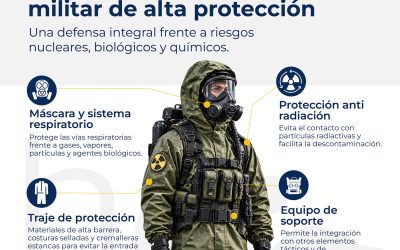
Hispano Vema specializes in protection against chemical warfare, providing decontamination equipment to counter nuclear, radiological, and chemical (NRC) agents. Today, we export to 57 countries and have maintained a strong partnership with the Ukrainian military since the start of the Russian invasion.
This international experience now allows us to diversify our portfolio with advanced camouflage and robotics. Our facilities are located on the Castellón highway, next to the López Soriano Recycling Technology Park (PTR), and have an average workforce of about 85 employees. We operate on a contract basis, so both our revenue and our team size vary depending on the orders.
Why the Defense Sector Needs Agile SMEs and Collaboration Among Companies
The defense sector is undergoing a profound transformation, as the war in Ukraine has shown. This has reignited fundamental debates, such as the percentage of a nation’s budget that should be allocated to defense, and has led governments—such as that of Aragon—to create a hub for the sector.
In this context, we advocate for the role of small and medium-sized enterprises. ““What we’re asking for is to be given a chance. If a large company is granted 500 million, an SME can be given three million to achieve significant results with much less infrastructure,” says José Antonio Navarro.
According to our founder, large companies have very cumbersome structures and development programs, while small and medium-sized enterprises (SMEs) adapt much more easily. He warns that government agencies continue to fund large programs that can drag on for years, when what is needed today is to “develop and react much more quickly.” That is why we are committed to strengthening collaboration among SMEs to create our own industrial ecosystem: “We don’t believe that everything has to be channeled through large companies.”
Camouflage and robotics share a common goal: fewer people exposed to risk
The risks on the ground are changing, and protection must evolve along with them. Our camouflage fabric, designed to conceal soldiers, tanks, and vehicles from night vision goggles and thermal sensors, aims to address one of today’s greatest challenges. And our commitment to robotics—with a robot dog for logistics and the potential use of drones in CBRN decontamination— aims for the same goal: for machines to take on the most dangerous tasks so that no soldier has to perform them.
With more than two decades of experience and a team of about 85 professionals, at Hispano Vema we have demonstrated that an Aragonese small and medium-sized enterprise can provide its own solutions in a sector dominated by large-scale programs. As we finalize the certification of our fabric with NATO armies and make strides in robotics, we are reinforcing a principle championed by our founder: in defense, the ability to respond is just as important as investment.
Frequently Asked Questions About Hispano Vema’s Camouflage Fabric and Robotics
What is Hispano Vema’s military camouflage fabric?
It is a material developed in Zaragoza to conceal soldiers, tanks, and logistics vehicles from night-vision goggles, thermal sensors, and detection systems.
How is it different from traditional camouflage?
Classic camouflage is designed to confuse the human eye. Our fabric is designed to conceal units from detection technologies such as night vision goggles and thermal sensors.
What threats does it protect against?
Against aerial threats, especially unmanned drones, which can render equipment costing millions of euros inoperable with little investment.
Is it available yet?
It is at an advanced stage of development, and we are finalizing the certification process with some of NATO’s leading armed forces.
What can it camouflage?
Soldiers, tanks, and logistics vehicles.
Questions About Robot Dogs and Drones
What is the purpose of Hispano Vema’s robot dog?
The robot dog is designed to transport logistical supplies—such as medications, objects, or weapons—in high-risk conflict zones, thereby preventing soldiers from having to enter dangerous areas.
Why are logistics so important in conflict zones?
Because the transport of supplies in conflict zones accounts for nearly 85% of the fatalities in a conflict.
What does Hispano Vema plan to do with drones?
We want to explore how to apply our expertise in NBC to robotics. For example, decontamination carried out using drones could require fewer personnel and be performed more quickly and effectively. This is a future direction—not yet an available product.
Questions About the Company
What does Hispano Vema do?
We are an Aragon-based company specializing in protection against chemical warfare, with decontamination equipment designed to counter nuclear, radiological, and chemical (NRC) agents.
In how many countries does it operate?
We export to 57 countries and have been working closely with the Ukrainian military since the start of the Russian invasion.
Where is the company located, and how many people work there?
We are located on the Castellón Highway, next to the López Soriano Recycling Technology Park (PTR). Our average workforce is about 85 employees, and this number varies depending on order volume.
Talk to our team about camouflage, robotics (robot dogs and drones), and NBC protection
If your organization is looking for advanced camouflage, CBRN protection, or robotics for hazardous environments, our team is here to help. Contact us and we’ll provide you with information about our products and their development status.