Mobility and telecommunications system
Increased speed, ergonomics and safety without relying on external resources
The mobility and telecommunications systems developed by Hispano Vema are a fundamental part of the deployments since, thanks to them, the movements of the systems are carried out more quickly, ergonomically and safely without the need to depend on external means, which makes the difference in the success or failure of the mission. In addition, the accessories help to generate the necessary comfort and well-being in external areas and episodes of conflict.
Mobility system

HISPANO VEMA - Sistemas de movilidad y telecomunicaciones SIMOCON

HISPANO VEMA - Sistemas de movilidad y telecomunicaciones SIMOCON

HISPANO VEMA - Sistemas de movilidad y telecomunicaciones SIMOCON

HISPANO VEMA - Sistemas de movilidad y telecomunicaciones SIMOCON

HISPANO VEMA - Sistemas de movilidad y telecomunicaciones SIMOCON
SIMOCON
The versatility of this mobility system allows the loading and unloading of containers up to 17 tons of aircraft manually and very safely in just a few minutes due to its free movement, allowing high precision, movement and subsequent transfer of containers on all types of surfaces.

HISPANO VEMA - Sistema de nivelación y elevación de contenedores

HISPANO VEMA - Sistema de nivelación y elevación de contenedores

HISPANO VEMA - Sistema de nivelación y elevación de contenedores
Container leveling and lifting system
Allows the deployment of containers in the field (loading/unloading) without the need for additional logistics equipment (crane, forklift, etc). Helping to reduce the Logistics Footprint in any deployment.
Its 4 cylinders can be operated individually to ensure proper leveling of the container on uneven terrain. The lifting mobility system is available in two versions: Integrated in the container (newly manufactured containers) or Portable (existing containers).
Telecommunications systems

HISPANO VEMA - ATQH

HISPANO VEMA - ATQH

HISPANO VEMA - ATQH

HISPANO VEMA - ATQH
ATQH
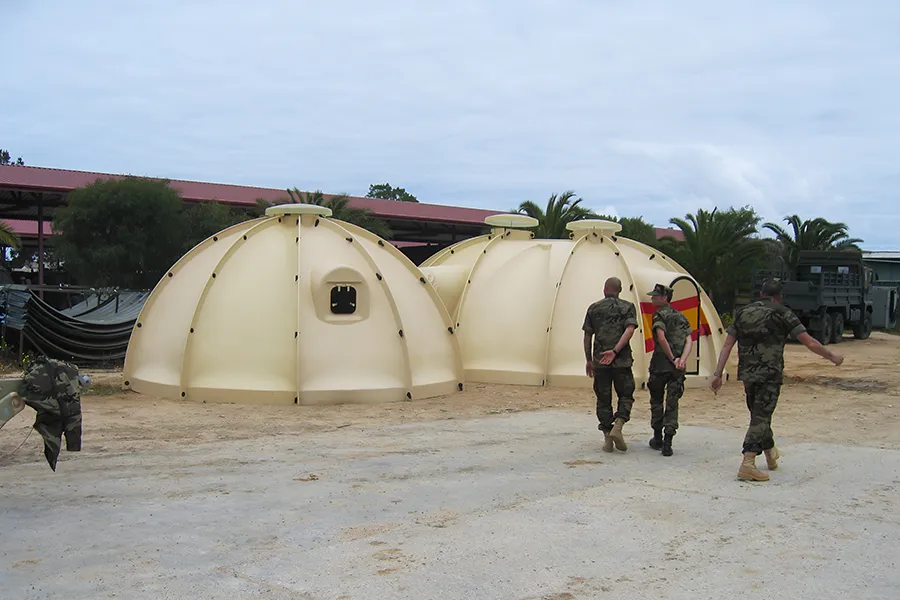
Manufactured in aluminum with state-of-the-art technology, these shelters are at the forefront of the world market and facilitate the integration of communications, saving space and optimizing operational efficiency.
Frequently asked questions: CBRN decontamination
Differences between AQUILES and AQUILES COMPACT
AQUILES decontamination equipment is manufactured in accordance with STANAG 4653. Combined operational characteristics, technical specifications, test procedures and evaluation criteria for chemical, biological, radiological and nuclear decontamination equipment.
DEPLOYMENT ALTERNATIVES
Thanks to its innovative modular design, the AQUILES decontamination equipment offers two deployment alternatives.
Self-employed
- In combination with decontamination shower ,odular
- Decontamination stations
- Integrated in decontamination stations.
- Integrated in rapid deployment systems.
What are the operational capabilities of our decontaminants?
The effectiveness of a decontamination process is based on the optimal functioning of three key elements
:
- Intervener
- Decontaminating agent
- Decontamination equipment
We must ensure the correct operation and interaction of these three parameters: we must have properly trained and qualified responders, while the decontamination equipment and decontamination agents must be appropriate to perform the
decontamination process for each Chemical, Biological or Radiological threat, attack or incident, applying the appropriate decontamination protocol for people, materials, vehicles, terrain, building interiors or sensitive material.
The storage, handling and transport of decontamination agents are fundamental to ensure effective decontamination. Climatic and environmental variations, especially humidity and temperature, can affect the decontamination effectiveness of the agents. Therefore, extreme precautions should be taken for their correct transport and storage, as indicated in STANAG 4370, AECTP 200, Environmental Testing, Environmental Conditions.
KEY ELEMENTS FOR EFFECTIVE DECONTAMINATION
- Multiscope agent
- Biological and chemical agents could be detoxified
- Radiological agents must be captured
- Skin care for people
- Different sheet materials
- Wide range of floor surfaces
- Unpredictable devices affected
- Functionality protection for sensitive devices
Our decontaminants have the capacity to detoxify and all of them have been tested both in laboratory (controlled and closed environment) and in real field (changing external conditions).
What is an EDECON?
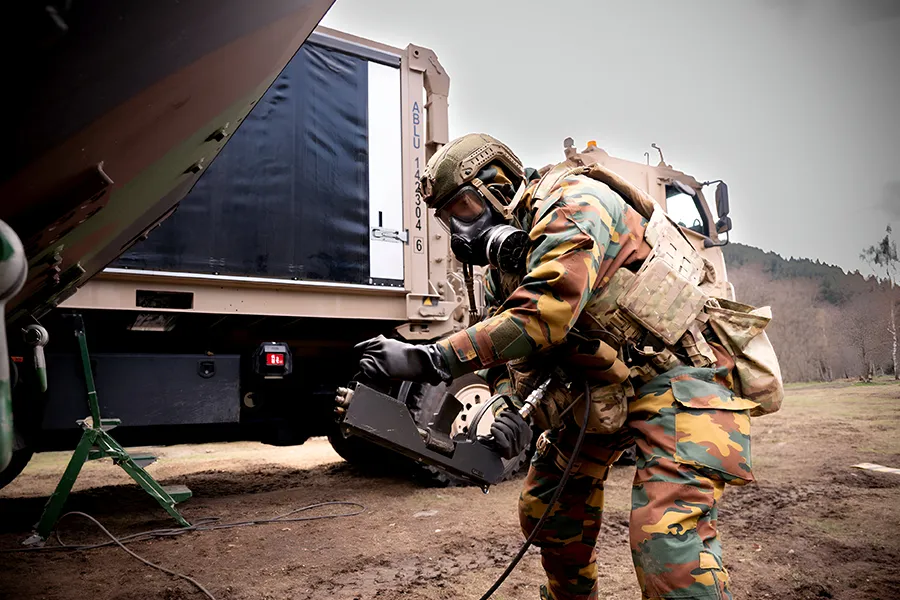
SMD Portable is based on the RD50 decontamination agent, its spray applicator has been developed to ensure easy access to all surfaces. The RD50 decontamination agent captures TICs and CWAs from the surface, generating a contaminated mixture (chemical agents and decontamination agent). SMD portable is equipped with a full range of tools to vacuum the contaminated mixture from the surface of the sensitive material and store it for later handling.
SMD portable is developed in accordance with STANAG 4653 combined operational characteristics, technical specifications, test procedures and evaluation criteria for chemical, biological, radiological and nuclear decontamination equipment.
EQUIPMENT
- Decontamination agent RD50 (400 ml) (20 spray cans).
- Vacuum cleaner and tools.
- Robust case for storage and transport (aluminum alloy).
- Removable inner box for handling and decontamination of devices in the Hot Zone.
What are the differences between an ATM2 and ATM10?
ATM2: The ATM 2/ATM 2-AP portable decontamination unit. It is the right equipment for immediate intervention and is indispensable for the protection of the individual in case of a disaster or a CBRN attack. Compatible with the use of all types of decontamination agents (both powder and liquid). It allows the decontamination of Vehicles, Materials, Interior of Buildings and Intervening Personnel (personnel with CBRN protective suit).
ATM10: The portable decontamination unit. ATM 10 is the right equipment for immediate intervention and is indispensable for the protection of the individual in case of a disaster or a CBRN attack. Compatible with the use of all types of decontamination agents (both powder and liquid). It allows the decontamination of vehicles, materials, building interiors and responders (personnel wearing protective suits).
Other products