
CBRN (Nuclear, Radiological, Biological and Chemical) decontamination is an essential process for safety in incidents involving hazardous agents, both in the civil and military fields. At Hispano Vema, experts in CBRN decontamination solutions, we develop decontamination systems and agents that guarantee an effective response to any threat, ensuring the protection of people, vehicles, materials and infrastructures.

What is CBRN decontamination and why is it crucial?
CBRN decontamination is the set of procedures aimed at eliminating or neutralizing contaminating agents of nuclear, radiological, biological or chemical origin. Its main objective is:
- To protect the life and health of exposed persons.
- Prevent the spread of contaminants to safe areas.
- Ensure safe return to operations or daily life.
The effectiveness of CBRN decontamination depends on the rapid detection, the delimitation of zones, the use of appropriate decontamination agents and the correct application of international protocols.
CBRN decontamination process: step by step
Below, we will detail the CBRN decontamination process, illustrated in our main infographic, which visually summarizes each critical phase.
Step 1: Detection and delimitation of contaminated area
The first action is to identify the presence of CBRN agents using specialized detection equipment. Once contamination is confirmed, three operational zones are delimited:
- Hot zone: area of maximum contamination.
- Temperate zone: for pollution reduction and decontamination.
- Cold zone: safe area free of hazardous agents.
This delimitation is key to controlling access and avoiding secondary dispersion of contaminants.
Step 2: Preparation of equipment and personnel
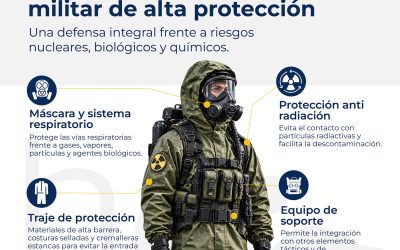
The intervening personnel must be equipped with CBRN protective suits, masks, gloves and safe communication equipment. Continuous education and training is essential to ensure the correct handling of decontamination agents and application equipment (high pressure, sprayers, etc.).
Step 3: Initial decontamination
A pre-wash is performed to remove as many surface contaminants as possible, typically using water or specific solutions, depending on the nature of the agent (chemical, biological, or radiological). In cases involving agents that react with water, appropriate solvents or open-air decontamination techniques are used.
Step 4: Decontamination of vehicles and equipment
The process for large vehicles and equipment is divided into three phases:
- Pre-treatment: removal of coarse dirt with high pressure water.
- Main treatment: application of specific decontamination products by means of high pressure pumps and, sometimes, thermal energy.
- Post-treatment: rinsing to remove residues and particles generated during decontamination.
Hispano Vema’s systems, such as EDEM and RELIDE, allow a fast and efficient response in complex scenarios, guaranteeing the decontamination of vehicles, materials and terrain.
Step 5: Evaluation, monitoring and safe reinstatement
Once decontamination is complete, a thorough evaluation is performed with detection equipment to ensure the absence of contaminants. Only after confirming effective decontamination, personnel, vehicles and materials can return to the safe area or continue with the mission.
Types of decontamination and decontamination agents
Decontamination of People
In CBRN incidents, the decontamination of people is a priority. Skin-protective and neutralizing solutions are used to remove contaminants without damaging the skin, eyes, or mucous membranes, whether the individuals are able-bodied or require assistance (injured or disabled). The protocols are designed to save lives and prevent secondary contamination.
Decontamination of vehicles and materials
For vehicles, infrastructure and equipment, decontamination agents developed for each type of threat (chemical, biological or radiological) are used, following international standards and ensuring maximum operational effectiveness.
Hispano Vema’s innovation and leadership in CBRN decontamination
Hispano Vema is positioned as a reference in CBRN decontamination solutions thanks to:
- Development of advanced decontamination agents and modular equipment adapted to each scenario.
- Compliance with international standards (STANAG 4653).
- Experience in complex and multi-sectoral projects, both nationally and internationally.
Compared to other competitors, Hispano Vema stands out for its specialization in CBRN decontamination, innovation in decontamination agents and the ability to customize solutions for defense, civil security and emergencies.
Want to know more about CBRN decontamination? Contact Hispano Vema!
If you need expert advice, information about our CBRN decontamination systems, or would like to request a personalized demonstration, Contact the Hispano Vema team. Discover how our solutions can make a difference in protecting against CBRN threats.
Request information now and ensure the security of your organization!