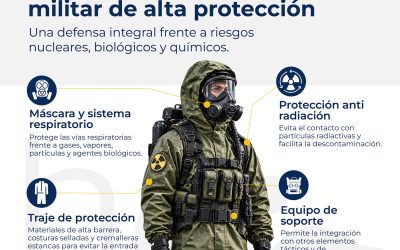
Protecting critical infrastructure against chemical, biological, radiological, and nuclear threats has become one of the main challenges for the Armed Forces, security agencies, and emergency services. In this context, Hispano Vema participated in the 19th edition of Defense Services Asia (DSA 2026), held April 20–23, 2026, at the Malaysia International Trade and Exhibition Centre (MITEC) in Kuala Lumpur.
DSA 2026 once again established itself as one of the leading international defense and security events in the Asia-Pacific region. Organized with the support of the Malaysian Ministry of Defense, the trade show brought together more than 1,400 exhibiting companies from 63 countries and welcomed more than 48,000 trade visitors, including 383 official delegations from 45 countries.
Under the theme “Enhancing Capabilities and Resilience Through Technology,” DSA 2026 focused on the evolution of smart defense technologies, operational resilience, and the ability to respond to emerging threats.

CBRNe Arena: New Capabilities for the Protection of Critical Infrastructure
Among the extensive program of activities and conferences, the CBRNe Arena stood out—a specialized venue dedicated to NBC capabilities and the challenges associated with chemical, biological, radiological, and nuclear threats.
The official opening ceremony of the CBRNe Arena was presided over by Lieutenant General Dato’ Mohamad Suria Bin Mohamad Saad, Deputy Chief of the Malaysian Army. The venue served as a meeting point for the Armed Forces, law enforcement agencies, emergency services, and specialized industry, facilitating the exchange of knowledge, the presentation of new capabilities, and the analysis of operational and technological trends in the CBRNe environment.
The growing presence of specialized facilities such as the CBRNe Arena reflects the strategic importance that CBRN threats have acquired in recent years, in both the military and civilian spheres.
Hybrid conflicts, the risks associated with the use of chemical and biological agents, the protection of critical infrastructure, and preparedness for highly complex incidents are driving the need for advanced solutions in detection, protection, decontamination, and crisis management.
In this context, CBRN decontamination systems play an essential role in the operational response, especially when it is necessary to protect strategic facilities and ensure the continuity of operations. The need to deploy capabilities that are rapid, modular, and adaptable to different scenarios is driving the development of mobile solutions with high capacity and greater operational flexibility.

Hispano Vema and the Challenge of NBC Decontamination in High-Risk Environments
Hispano Vema, a recognized global leader in the design and manufacture of CBRN decontamination systems, was selected to participate in the series of conferences held at the CBRNe Arena and to share its experience and technological expertise in the field of CBRN decontamination.
In the presentation titled “Operational CBRN Decontamination in High-Threat Environments,” Rafael Arruga, Director of Business Development at Hispano Vema, analyzed the main operational challenges faced by CBRN units—both military and civilian—especially in complex and highly uncertain scenarios.
Protecting critical facilities and infrastructure against potential CBRN incidents requires capabilities that enable a rapid and effective response to various types of threats. In this regard, decontamination is a fundamental capability within response and recovery protocols.
Referring to the main STANAGs applicable to CBRN decontamination—STANAG 2352, STANAG 4653 (AEP-58), and STANAG 4521 (AEP-07)—Arruga explained how the industry is developing new technologies, systems, and equipment to strengthen response capabilities and resilience against chemical, biological, and radiological threats.

Mobile decontamination stations for various scenarios
During the presentation, special emphasis was placed on NBC Mobile Decontamination Stations. Their versatility allows them to address the three levels of decontamination defined in STANAG 2352—operational, thorough, and complete—in a wide variety of environments.
These solutions can be deployed in urban areas as well as at critical infrastructure sites, strategic facilities, rural areas, or hard-to-reach locations. Their flexibility allows the response capacity to be tailored to the specific characteristics of each scenario.
The stations are designed to provide an effective response to various threats, including CWAs, TICs, biological agents, and radiological particles. The ability to respond to different types of contaminants is particularly important in scenarios where the protection of people, equipment, and facilities must be carried out quickly and in a coordinated manner.
Preparedness for radiological particles and other contamination risks also requires specific radiation protection capabilities, especially in environments where strategic facilities or critical infrastructure may be affected.

International Reach and Spanish Participation
Beyond the attendance records set by DSA 2026, the organizers highlighted the success of the CBRNe Arena, which addresses the growing global concern among the armed forces and security and emergency agencies regarding CBRN threats.
Protecting critical infrastructure against unconventional scenarios has become a priority for many countries, especially in light of the evolution of hybrid conflicts and the emergence of new threats. The combination of detection, protection, decontamination, and response capabilities helps strengthen the resilience of essential facilities and services.
At the national level, the Spanish defense industry was once again well represented, backed by the support provided by OFICAEX. The delegation from the Spanish Ministry of Defense was led by Mr. Héctor Casado López, Deputy Director of the General Directorate for Strategy and Innovation in the Defense Industry (DIGEID), underscoring the institution’s commitment to the internationalization of the Spanish defense industry and its positioning as an international leader.
In addition, the delegation from the Ministry of Defense was supported by a delegation from the Spanish Embassy in Kuala Lumpur, led by His Excellency Mr. José Luis Pardo Cuerdo, Spain’s Ambassador to Malaysia, who expressed interest in the activities in Malaysia and the Asia-Pacific region of the Spanish defense industry companies participating in the trade show.
The CBRNe Arena event at DSA 2026 confirms the Asia-Pacific region’s growing interest in strengthening its preparedness and response capabilities against unconventional threats.
International cooperation among the armed forces, government agencies, emergency services, and specialized industries is key to developing new capabilities designed to protect the population, strategic facilities, and critical infrastructure against CBRN threats.
In this area, the incorporation of advanced detection, radiation protection, and decontamination technologies helps improve preparedness for threats that may involve chemical agents, biological agents, or radiological particles.
Through initiatives such as the CBRNe Arena, DSA continues to strengthen its position as one of the leading international forums for analyzing future challenges in defense, security, and CBRN protection.
Hispano Vema’s participation in DSA 2026 highlights, once again, the importance of developing NBC decontamination solutions capable of meeting the needs of military and civilian units and contributing to the protection and resilience of critical infrastructure in the face of highly complex threats.