
The Spanish company Hispano Vema is working on one of the most ambitious projects in recent years within the European defense industry:an innovative, invisible military fabric designed to reduce detectability by thermal cameras, infrared sensors, night vision devices, and reconnaissance systems used by state-of-the-art drones to virtually zero.
The project, currently in an advanced stage of evaluation and operational testing, has already attracted the interest of several NATO member countries , which are considering its potential adoption for future use by special operations units and rapid deployment forces.
The emergence of new technological threats on the modern battlefield—particularly the widespread use of surveillance drones and artificial intelligence systems for visual reconnaissance—has made the development of smart military camouflage solutions a strategic priority for many Western militaries.
A New Technological Breakthrough in Smart Military Camouflage
The new material developed by Hispano Vema combines advanced composite materials with specific treatments capable of altering the thermal and electromagnetic signature of the user or the vehicle to which it is applied.
In practical terms, this technology makes it extremely difficult for the following to detect it:
- Thermal Cameras
- Infrared Systems
- Aerial Reconnaissance Sensors
- Autonomous Surveillance Platforms
- Tactical drones equipped with AI
- Night-vision equipment
The key to the system lies in its ability to reduce detectable thermal emissions, which represents a significant advance in the field of thermal invisibility as applied to the military.
Until now, many traditional camouflage systems were effective only against the human visual spectrum. However, modern conflicts have shown that today’s threats increasingly come from automated sensors and drones capable of identifying targets based on body temperature, movement, or electromagnetic contrast.
For this reason, the development of fabrics capable of eliminating or distorting the thermal signature represents a technological advancement of enormous strategic importance.

The rise of drones is changing the rules of modern combat
Recent wars have highlighted the impact of tactical drones on reconnaissance, surveillance, and target acquisition operations. Both small commercial UAVs adapted for military use and advanced aerial surveillance platforms have become essential tools in any combat scenario.
This new context has forced militaries to completely rethink their concealment and tactical survival systems.
Current detection systems can locate combatants or vehicles even in low-visibility conditions thanks to the combined use of:
- Temperature Sensors
- Artificial Intelligence Recognition
- Multispectral cameras
- Low-signature radar
- Advanced Infrared Detection
Given this reality, solutions such as the new invisible military fabric developed in Spain could profoundly change the operational capabilities of special forces and infiltration units.
Especially during nighttime operations, in urban environments, or on deep reconnaissance missions, having smart military camouflage systems capable of reducing exposure to drones could make a decisive difference on the ground.
Testing in Multiple Operating Environments
According to the information available so far, the fabric is currently undergoing advanced simulations and testing in various climatic and geographic scenarios.
The essays include:
- Wooded areas
- Desert regions
- Mountainous areas
- Night Operations
- Urban Simulations
- Tactical Infiltration Maneuvers
The goal is to test the material’s ability to maintain a minimum detection level in real combat situations and under various environmental conditions.
The company’s initial results have been described as “highly promising,” especially when compared to thermal systems used by surveillance drones.
One of the most significant aspects of the project is that it is not limited solely to personal uniforms. Industry experts believe that this technology could also be adapted to:
- Military vehicles
- Advanced Positions
- Reconnaissance Teams
- Tactical Shelters
- Critical Infrastructure
- Mobile Surveillance Systems
The material’s versatility opens the door to a wide range of future applications in the fields of advanced protection and technological warfare.
Spain Gains Influence in the European Defense Industry
The development spearheaded by Hispano Vema also reflects the growth of Spanish industry within the European defense and security sector.
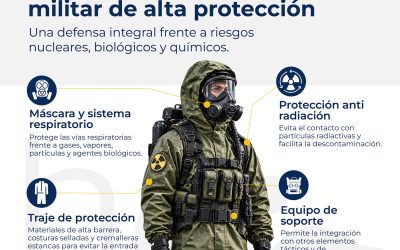
Traditionally specializing in NBC (nuclear, biological, and chemical) solutions, the company has diversified its investments into strategic areas related to:
- Tactical Protection
- Electronic warfare
- Survival Systems
- Anti-drone technology
- Advanced Materials
- Multispectral protection
This move is in line with Europe’s growing commitment to strengthening its own industrial capabilities in the defense sector, particularly in technologies considered critical to continental security.
Spain, which in recent years has increased its participation in international military technology programs, is beginning to establish itself as a major player in highly specialized areas of tactical innovation and advanced protection systems.

NATO is considering its possible approval
The interest sparked by this system has already reached various NATO-affiliated organizations, which are analyzing its potential integration into future operational doctrines.
Approval by the Atlantic Alliance would provide a huge boost to the project, allowing for its gradual integration into special operations units and rapid deployment forces.
Although most of the technical specifications remain strictly confidential, various industry sources believe that this development could become one of the most significant advances made in Europe in the field of thermal invisibility and advanced camouflage.
Furthermore, international interest confirms an increasingly clear trend: modern warfare is also fought in the realm of electronic detection and sensory superiority.
In this scenario, technologies capable of “disappearing” from smart sensors could redefine the future of tactical combat over the coming decades.
The Future of Invisible Military Fabric
Advances in surveillance systems, automatic recognition, and autonomous drones are driving the development of new concealment solutions that are far more sophisticated than conventional camouflage systems.
The Hispano Vema project embodies precisely this new generation of defense technologies, in which smart materials, thermal control, and electronic signature reduction are integrated into a single operational solution.
Although there are still validation and certification phases to be completed, all signs point to Spain potentially taking the lead in a technology with enormous strategic and commercial potential on the international stage.
The race to dominate the invisible battlefield has already begun, and the development of this new invisible military fabric could become one of the most important milestones in European military innovation in the coming years.
If you want to stay up to date on military innovation, anti-drone technology, European defense, and new smart military camouflage systems, subscribe to our newsletter and receive our latest analyses and news directly in your inbox.