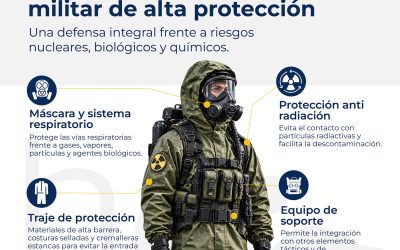
Hazardous and toxic materials pose a growing challenge for the Armed Forces, emergency services, security agencies, and industries operating in high-risk environments. The potential for exposure to chemical, biological, or radiological agents calls for the development of new solutions capable of protecting professionals who respond to these types of incidents.
In this context, technological innovation plays a key role. CBRN detection, protection, and decontamination systems, together with the use of unmanned ground vehicles (UGVs), help reduce human exposure and improve the ability to respond to incidents involving hazardous materials.
An overview of the latest advancements in this field was presented at the CBRNe Protection Symposium 2025, held in Malmö, Sweden, from September 30 to October 2 and organized by the Swedish Defense Research Agency (FOI).

CBRNe Protection Symposium 2025: An International Leader in CBRN Protection
The CBRN Protection Symposium dates back to the 1980s and has established itself as one of the leading international gatherings of the CBRN community.
The fifteenth edition brought together more than 700 participants from over 30 countries, including representatives from the armed forces, security and emergency agencies, academic institutions, and specialized companies in the sector.
The program combined an extensive schedule of scientific and technical conferences with an exhibition area featuring more than 60 companies. Attendees were able to learn about state-of-the-art technologies related to the detection, protection, and decontamination against chemical, biological, nuclear, and radiological threats.
The 2025 edition was inaugurated by Sweden’s Minister of Civil Defense, Carl-Oskar Bohlin, along with Jens Mattsson, Director General of the Swedish Defense Research Agency (FOI); Bryan Wells, former NATO Chief Scientist; and Gaëtan Boireau, Head of the NBC Office at the Joint Staff of the French Ministry of Defense.
The evolution of threats drives new solutions
The scope of NBC protection has evolved considerably in recent decades. While the early editions of the Symposium focused primarily on chemical and biological threats, recent editions have also incorporated nuclear and radiological risks, giving rise to the current CBRNe approach.
During the three-day event, strategic and technological issues related to the following were discussed:
- Emerging Threats.
- Threat Detection.
- OPCW Special Session.
- Special Ukraine.
- Special Disinformation.
- Modern Biodetection.
- Forensic Analysis.
- Protective Materials.
- Healthcare Strategies.
- Mass Casualty Prevention.
- AI Preparedness.
- Identification & Monitoring.
- Decontamination.
- International Cooperation.
This diversity of topics reflects the need to develop a comprehensive response to increasingly complex threats, which may involve a combination of hazardous materials, industrial toxic agents, chemical, biological, or radiological threats, and large-scale emergency scenarios.

UGV: Technology to Reduce Exposure to Hazardous Materials
One of the highlights of the Symposium was the session on International Cooperation, during which Colonel Zvonko Orehovec of Croatia presented the paper “UGV-based technologies for CBRNe Response.”
The presentation focused on unmanned ground vehicles (UGVs), a technology with significant potential for NBC operations and the management of incidents involving hazardous materials.
In these types of scenarios, protecting the professionals who enter the affected area is a priority. An incident can occur in either a military or terrorist context—for example, involving chemical, biological, or nuclear weapons—or in a civilian setting, such as a nuclear power plant, a chemical industry facility, a pandemic, or an accident involving toxic industrial materials.
The use of unmanned vehicles makes it possible to transfer certain high-risk tasks from people to robotic platforms. In this way, access to the hot zone can be achieved using the UGV, significantly reducing the direct exposure of responders to contaminants.
This capability is particularly important when the nature, concentration, or distribution of the contaminant is initially unknown.

MVF-5: Advanced Capabilities Against Toxic Materials and CBRN Threats
During the symposium, Colonel Orehovec presented the MVF-5, a hybrid-powered UGV developed by the Croatian company DOK-ING to operate in extreme and high-risk environments.
The platform integrates various capabilities designed to improve the safety and effectiveness of response operations for CBRN incidents and situations involving hazardous materials.
Its key capabilities include:
CBRN Reconnaissance, Survey, and Detection
The MVF-5 can perform reconnaissance, patrol, and surveillance missions, incorporating various sensors and NBC detectors, as well as an advanced video system.
These capabilities make it possible to gather information about the environment without exposing operators to direct danger.
Real-time data collection and analysis
The platform enables the collection, processing, and analysis of data in real time. This information facilitates a better understanding of the situation and provides relevant data to the commanders and operational units responsible for managing the emergency.
Decontamination of Hazardous Materials
One of the most important capabilities is chemical, biological, and radiological decontamination.
The system also enables the neutralization of toxic industrial materials (TIM) on vertical and horizontal surfaces, as well as on combat and non-combat equipment. In addition, it incorporates partial self-decontamination capabilities.
These features make it possible to carry out certain decontamination operations while keeping professionals away from the highest-risk area.
Fire Suppression and Neutralization of Toxic Substances
The MVF-5 is equipped with capabilities for firefighting, demolition, and the neutralization of toxic chemicals.
Its self-cooling system, along with its fire suppression and sprinkler systems, allows it to operate in high-temperature conditions and in particularly demanding environments.
Sampling in Contaminated Areas
Another key capability is the ability to take samples directly from the hot zone. The system can collect gases, vapors, dust, aerosols, liquids, and solids, facilitating their subsequent analysis and characterization.
Overcoming Obstacles
The UGV is also designed to overcome and remove obstacles using various interchangeable tools located at the front and rear of the platform.
This versatility is particularly important in emergency situations where terrain conditions can change rapidly.
HISPANO VEMA: Decontamination Systems for High-Risk Environments
The decontamination capabilities of the MVF-5 UGV presented at the symposium are based on NBC decontamination systems developed by HISPANO VEMA.
The collaboration between DOK-ING, which specializes in robotic systems for extreme environments, and HISPANO VEMA, which specializes in CBRN decontamination solutions, has led to the development of a robotic CBRN emergency response system.
The goal is to provide advanced decontamination capabilities in high-risk environments, thereby reducing the need for operators to be exposed to chemical, biological, or radiological agents.
The integration of robotics and decontamination technology represents a significant advance in the management of incidents involving hazardous or toxic materials, especially when on-site conditions make direct human intervention particularly risky.
Robotics as a Key Element in Protection Against Hazardous Materials
The integration of UGV systems into NBC operations reflects an increasingly significant trend: keeping humans away from the most dangerous areas through the use of unmanned technologies.
In an incident involving hazardous materials, having a platform capable of accessing the contaminated area, detecting agents, taking samples, gathering information, and performing certain decontamination tasks can improve both the safety of responders and the ability to respond.
In addition, the integration of sensors, video systems, data analysis, and decontamination capabilities opens up new possibilities for addressing complex and dynamic scenarios.
For this reason, robotics applied to CBRN protection should not be viewed solely as a tool for automation, but rather as a means of protecting people.

A Future Shaped by Cooperation and Innovation NBQ
The 2025 CBRNe Protection Symposium once again demonstrated the importance of international cooperation in addressing constantly evolving threats.
The combination of scientific research, military and civilian capabilities, industrial innovation, and international cooperation is essential for improving preparedness for incidents involving hazardous materials, toxic substances, and CBRN agents.
In this context, technologies such as the MVF-5 and the CBRN decontamination systems developed by HISPANO VEMA serve as an example of how the integration of robotics and CBRN protection can help reduce workers’ exposure and improve emergency management in high-risk environments.
The evolving nature of threats—from industrial accidents to scenarios involving hybrid warfare, terrorism, or radiological emergencies—makes it necessary to continue developing solutions capable of detecting, identifying, protecting against, decontaminating, and responding to hazardous materials quickly and safely.
Technological innovation and international cooperation will therefore be two fundamental pillars for strengthening resilience and the ability to respond to future CBRN challenges.