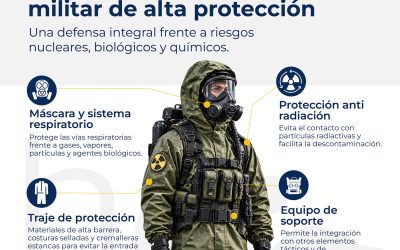
NBC decontamination protocols state that decontamination of people is a priority:
- To save the life of the affected person, eliminating contaminating agents from the body surface.
- Prevent the contaminated person from contaminating others.
Decontamination agents used in the decontamination of people, whether valid or assisted (injured or disabled) must provide a dual function:
- Ensure that an effective decontamination of pollutants is obtained.
- Do not damage sensitive parts of the body: skin, eyes, nose, etc.
Manufacturers of NBC Decontamination solutions must develop Decontamination Agents with formulas based on dermogels and neutralizing components; as a means to ensure this double challenge: to ensure an effective decontamination of the affected person, but without damaging the most sensitive parts of the body: skin, eyes, mucous membranes, etc.
The next factor that NBC decontamination protocols take into account is the type of contaminating agent: Chemical Agents, Biological Agents and Radiological Agents. Depending on the type of agent that has caused the contamination, an appropriate decontamination should be applied to it.
Chemical Warfare Agents (CWA)
The scientific literature usually establishes 5 major categories within the CWAs:
- Disabling agents: are divided between Neutralizing (causing temporary irritations) and Soothing (causing long-lasting irritations).
- Nerve or neurotoxic agents: are usually divided between Nerve Agents Series G (Tabun, Sarin, etc.) and Nerve Agents Series V (agent VX, …).
- Blood agents: Are absorbed and transported by the blood, having a systemic effect, interfering in the Oxygen-CO2 exchange of blood hemoglobin.
- Vesicant agents: may be in solid, liquid or gaseous form, and on contact with the skin produce irritation and blistering. They can cause from mild skin irritation to ulceration and destruction of tissues.
- Nemo toxic agents: substances that cause physical damage to the lungs, their exposure is through inhalation or contact.
In all cases the process of decontamination of people requires a quick and thorough washing of the skin, eyes and mucous membranes with a neutral dermogel solution (pH 7), which is precisely the basis for the formulation of specific decontamination agents for use on people.
In addition, the decontaminating agent must have components in its formulation that neutralize the chemical agents, degrading them into compounds that are harmless to the human body. This process is known as detoxification.
An important consideration about the decontamination and detoxification processes to be taken into account is that these processes refer to the decontamination of the agents found on the skin of the affected person. For chemical agents already inside the human organism (having been inhaled or absorbed through the skin or mucous membranes), specific medical treatment is necessary.


Biological Agents
The scientific literature usually establishes 3 main categories within biological agents:
- Toxins (Botulinum, Ricine, Palytoxine, etc.)
- Bacteria (Yarsinia Pestis, Cholera, Bacillus Anthracis, etc.)
- Viruses (Nipah, Dengue, Zika, etc).
One of the main characteristics of biological agents is their broad spectrum of “Time of Effect”. The Time of Effect measures both the period elapsed from exposure to the biological agent until the affected person suffers the first symptoms of contamination and the maximum time in which the affected person must be decontaminated before suffering irreversible damage to his/her health and/or life.
One of the great challenges in the management of NBC incidents with biological agents is precisely that the great dispersion in the Time of Effect (from a few minutes in the case of Toxins to several hours or even weeks in the case of Bacteria and Viruses) causes great difficulty in identifying contaminated persons and being able to decontaminate and isolate them to prevent them from contaminating other people.
In this context, the scientific literature establishes the following ranges of “Time of Effect” depending on the category of Biological Agent:
For Toxins: between 0 minutes and 1.5 hours
For Bacteria: from 8 hours to 15 days
For Viruses: from 8 hours to 15 days.
In all cases, the process of decontamination of people requires a quick and thorough washing of the skin, eyes and mucous membranes with a neutral dermogel solution (pH 7), which is precisely the basis for the formulation of specific decontamination agents for use on people.
In addition, the decontaminating agent must have biocidal components in its formulation that provide sterilizing properties, eliminating any pathogenic agent of biological origin from the skin of the affected person. This process is known as Detoxification.
As with chemical agents, an important consideration about the processes of decontamination and detoxification of biological agents that must be taken into account is that these processes refer to the decontamination of agents that are on the skin of the affected person. For chemical agents already inside the human organism (having been inhaled or absorbed through the skin or mucous membranes), specific medical treatment is necessary.
Radiological Agents
Hazmat incidents caused by radiological agents refer to any form of incident caused by a radioactive agent or the contamination of an area with radiological sources.
Incidents involving radiological agents are usually caused by: civilian accidents (nuclear power plants, medical centers, research centers, etc.), dirty bombs (involving non-nuclear radiological agents), poisoning with radiological agents, etc.
The emission of radiation by some chemical elements is the result of the nuclear decay of these elements, and usually has a life of hundreds or thousands of years, so the decontamination process is not focused on the elimination of radiation, but on the removal of radioactive particles that are on the surface of the contaminated person.
The process of decontamination of people requires a quick and thorough washing of the skin, eyes and mucous membranes with a neutral dermogel solution (pH 7), which is precisely the basis for the formulation of specific decontamination agents for use on people.
In addition, the decontaminating agent must have chelating compounds in its formulation that facilitate the dragging effect of the radioactive particles present in the body of the contaminated person.
It is important to highlight that, as in the decontamination of biological and chemical agents, the detoxification process allows the neutralization/elimination of the contaminating agent. Due to the nature of radiological agents this process is not feasible, and the only objective of decontamination is the total removal of the radiological agent from the surface of the body of the affected person.


Location and Location
Finally, NBC decontamination protocols pay special attention to the place where the decontamination of the affected persons in a NBC incident should be performed, as well as the time in which it should be carried out.
In this context, one of the most universally accepted guidelines within Hazmat or NBC incident management agencies and units is STANAG 2228 AJP 4.10B (Allied Joint Medical Support Doctrine) published by NATO, which establishes 5 fundamental premises for casualty management in NBC environments:
- NBC incidents are likely to result in a large number of casualties
- The types of casualties in a NBC incident are not those normally handled in a military medical support system.
- NBC casualties may be contaminated or contagious, and may pose a significant hazard to medical personnel and care facilities.
- Sanitary Treatment Facilities (STFs) may have to operate in areas that are contaminated, or with restrictions that limit the movement of personnel and material in and out of the STF.
- Medical assistance will continue to be required for conventional casualties as well as for NBC casualties.
This same STANAG 2228 AJP 4.10B, in the specific section referring to the decontamination of patients, establishes 4 basic principles:
- Reducing the risk of contamination of medical personnel and other patients
- It should be performed as soon as patient stabilization permits.
- It must be decentralized to avoid creating waiting times at a centralized point.
- Each Sanitary Treatment Formation (STF) shall have its own Decontamination Area (either a Decontamination Shower or a mass decontamination station).