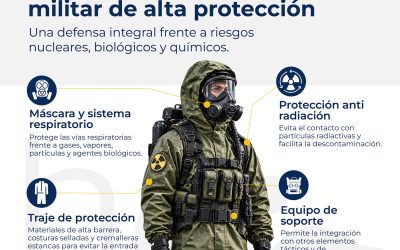
Managing a CBRN incident is one of the greatest challenges facing emergency services, law enforcement, and specialized civil protection teams. The potential presence of chemical agents, biological materials, radiological substances, or nuclear materials makes these types of incidents highly complex scenarios, where a rapid, coordinated response based on well-defined protocols is essential to minimize risks to the public, responders, and the environment.
Although these incidents have traditionally been associated with military conflicts or terrorist threats, reality shows that a CBRN incident can also occur in industrial settings, during the transport of hazardous materials, in research laboratories, hospitals, or critical infrastructure. An accident at a chemical plant, a leak of toxic substances, or a spill during transport can trigger an emergency requiring the immediate intervention of specialized teams.
The evolution of threats and the increase in the international transport of hazardous materials have driven the development of increasingly rigorous procedures for risk identification, the establishment of safety zones, the protection of personnel, and the decontamination of people, equipment, and vehicles. These protocols make it possible to significantly reduce exposure to hazardous substances and ensure an effective response even in the most critical situations.
In this article, we will take an in-depth look at what a CBRN incident is, what its main characteristics are, and how emergency services should respond during all phases of the response. In addition, we will discuss the importance of identifying chemical agents, vehicle decontamination procedures, and the technologies that currently enable a faster and safer response to these types of threats.

What is an NRBQ incident?
A CBRN incident is any emergency situation in which substances or materials of a nuclear, radiological, biological, or chemical nature are present or suspected to be present and may pose a risk to human health, infrastructure, or the environment.
The acronym NRBQ refers to four categories of threats:
- Nuclear
- Radiology
- Biological
- Chemistry
Each of them has specific characteristics, but they all share one thing in common: they require different response procedures than those used in a conventional emergency.
The severity of a CBRN incident does not depend solely on the material involved. Factors such as weather conditions, wind direction, population density, the type of facility affected, or the duration of exposure can significantly alter the scale of the emergency.
For this reason, international protocols stipulate that any suspected contamination must initially be treated as a high-risk incident until specialized teams can confirm or rule out the presence of hazardous substances.
Types of CBRN Incidents
Chemical Incidents
These are the most common types of CBRN emergencies.
They result from the accidental or intentional release of chemical agents capable of harming people through inhalation, contact, or ingestion.
Among the most common causes are:
- Industrial accidents.
- Spills during transport.
- Leaks at chemical facilities.
- Industrial Fires.
- Improper handling of hazardous materials.
- Deliberate acts.
Depending on the compound released, the effects may appear immediately or after several hours of exposure.
Some chemical agents affect the respiratory system, while others cause burns, neurological disorders, or damage to internal organs.
Early identification of the contaminant is essential for determining the level of protection required and selecting the appropriate decontamination procedures.
Biological Incidents
In this type of emergency, microorganisms capable of causing disease in humans, animals, or plants are involved.
Biological threats may be related to:
- Virus.
- Bacteria.
- Fungi.
- Spores.
- Biologically derived toxins.
The main challenge is that symptoms often appear hours or even days after exposure, making it difficult to identify the source of the incident.
Radiological Incidents
They occur when there is an accidental or intentional release of radioactive materials without a nuclear reaction taking place.
They may be related to:
- Medical equipment.
- Laboratories.
- Research centers.
- Transportation of radioactive sources.
- Industrial facilities.
In these cases, the priority is to limit exposure time, increase the distance from the source, and use appropriate shielding materials.
Nuclear incidents
These are the least common, although they are potentially the most serious.
These include accidents at nuclear facilities or situations involving fissile material capable of producing a chain reaction.
Due to their complexity, they require the coordinated efforts of specialized national and international organizations.

Characteristics that distinguish a CBRN incident from other emergencies
One of the main challenges of a CBRN incident is that the danger is often invisible.
Unlike a fire or an explosion, many hazardous substances have no color, odor, or obvious signs that would allow them to be quickly identified.
This requires emergency services to initially act in accordance with the principle of maximum caution.
Among the most important features are:
- Invisible pollution.
- It can be transmitted through the air, water, or surfaces.
- Risk of secondary contamination.
- Need for specialized equipment.
- Mandatory decontamination procedures.
- Use of specific detectors.
- Coordination among multiple agencies.
In addition, a single incident can involve multiple threats at the same time.
For example, an explosion at a chemical plant can simultaneously cause fires, the release of toxic gases, structural collapse, and environmental contamination.
Priority Objectives During a CBRN Incident
The initial response should focus on minimizing the consequences of the incident as much as possible.
The priority objectives are:
Protecting the population
People’s safety is always the top priority.
Depending on the situation, it may be necessary to order:
- Evacuations.
- Lockdowns.
- Access Restrictions.
- Traffic control.
- Quarantine of the area.
These decisions must be made quickly and be based on technical information gathered by specialized teams.
Protecting the participants
Emergency responders should never enter a potentially contaminated area without the appropriate level of protection.
Acting hastily can turn the rescuers themselves into new victims, making it even more difficult to manage the emergency.
For this reason, before beginning any operation, it is essential to assess the existing risks, identify the possible chemical agents involved, and select the appropriate personal protective equipment.

The protocol for responding to a CBRN incident
The response to a CBRN incident cannot be improvised. The potential presence of hazardous substances requires following a structured procedure that minimizes exposure to those affected and ensures the safety of emergency responders.
Although each country adapts the protocols to its own regulations and the structure of its emergency response agencies, the operational sequence generally follows a series of common phases.
1. Receipt of the Notice and Initial Assessment
It all begins with the receipt of an alert. This alert may come from citizens, businesses, industrial facilities, public agencies, or automated detection systems.
During this phase, it is essential to gather all available information before mobilizing resources. Among the most relevant data are:
- Exact location of the incident.
- Type of affected facility.
- Estimated number of people involved.
- There are injured people.
- Presence of smoke, fumes, or spills.
- Weather conditions.
- Possible chemical agents involved.
This initial assessment will determine whether there is reasonable suspicion of a CBRN incident and allow for the mobilization of the necessary specialized resources.
2. Mobilization of specialized resources
When there are indications of chemical, biological, radiological, or nuclear contamination, the coordination center mobilizes the appropriate teams.
Depending on the scale of the emergency, the following may be involved:
- Firefighters specializing in technological hazards.
- Healthcare equipment.
- Law enforcement agencies and security forces.
- Civil Protection.
- Specialized military units.
- Hazardous Materials Technicians.
- Decontamination units.
In large-scale incidents, mobile laboratories, environmental analysis units, and forward coordination centers may also be deployed.
Arrival at the scene of the incident
The arrival of the first teams is one of the most delicate moments.
The goal is not to intervene immediately, but to assess the situation without increasing the number of casualties.
First responders must maintain a sufficient safety distance while conducting an initial assessment.
During this visual inspection, indicators such as the following may be identified:
- Clouds of steam.
- Unusual odors.
- Spills.
- Damaged containers.
- ADR Signage.
- Hazardous substance labels.
- Unconscious people.
- Affected animals.
- Damaged vegetation.
All of this information is essential for guiding the rest of the intervention.

Identification of Chemical Agents
One of the most important aspects during a CBRN incident is correctly identifying the chemical agents that may be present.
Acting quickly at this stage makes it possible to select the appropriate protective equipment and apply the most effective treatment.
Various systems can be used for this purpose.
Portable detectors
Modern detectors can identify numerous hazardous substances in just a few seconds.
Notable among them are:
- Toxic gas detectors.
- Portable spectrometers.
- Photoionization detectors.
- Raman instruments.
- Infrared detectors.
These devices provide immediate information without the need for direct contact with the substance.
ADR Signage
When an incident involves the transport of dangerous goods, ADR signage provides very useful information.
Orange signs and hazard labels provide the following information:
- Type of product being transported.
- Major Risks.
- Recommended intervention measures.
Thanks to this information, emergency services can make decisions much more quickly.
Information About the Facility Manager
If the incident occurs at a chemical plant or facility, technical staff can provide key information regarding:
- In-stock products.
- Industrial processes.
- Specific risks.
- Safety Data Sheets.
- Compatibility between substances.
This information significantly reduces the time needed to identify the chemical agents involved.
Establishment of the Security Perimeter
Once the risk has been assessed, one of the most important phases of any CBRN incident begins: defining the scope of the incident.
To prevent the spread of contamination, three operational zones are established.
Hot Zone
This is the area where contamination has been confirmed or is highly likely.
Only specially trained and equipped personnel may enter.
Operations such as the following are performed in this area:
- Rescue.
- Identification of substances.
- Leak Detection.
- Spill containment.
- Initial care for victims.
Exposure times are usually limited to reduce exposure.
Temperate zone
The temperate zone serves as a transition zone.
Essential tasks such as the following are carried out here:
- Initial decontamination.
- Equipment change.
- Health inspection.
- Classification of victims.
- Operational coordination.
In many cases, this is where decontamination stations are set up.
Cold Zone
The cold zone is considered free of contamination.
The following are coordinated from there:
- Forward command post.
- Comprehensive health care.
- Communications.
- Logistics.
- Media outlets.
- Receipt of new resources.
Properly separating these three areas is essential to prevent contamination from spreading.
Protection of Emergency Services
Emergency services are one of the most valuable resources during any operation.
However, they are also particularly vulnerable.
Accidental exposure could render personnel essential to managing the emergency unable to work.
Therefore, all personnel must use protective equipment appropriate to the level of risk.
Personal Protective Equipment
Depending on the type of CBRN incident, different levels of protection may be used.
Among the most common elements are:
- Dry suits.
- Chemical gloves.
- Boots resistant to corrosive substances.
- Self-contained breathing apparatus.
- Protective masks.
- Integrated communication systems.
The choice always depends on the identified pollutant.
Exposure Time Control
Even when using the proper equipment, responders cannot remain in the hot zone indefinitely.
Each intervention should be planned with the following in mind:
- Ambient temperature.
- Air consumption.
- Physical fatigue.
- Complexity of the mission.
- Risk posed by the contaminant.
Scheduled shifts help ensure the safety of the operation.
Initial Care for Victims
Once the safety of the teams has been ensured, the rescue of those affected begins.
However, in an NRBQ incident, the procedure differs significantly from that used in other emergencies.
Victims cannot be taken directly to the hospital if there is a risk of contamination.
First, they must undergo an evaluation and decontamination process.
During this phase, priority is given to:
- Unconscious people.
- Critically ill patients.
- Children.
- Older adults.
- Pregnant women.
- People with limited mobility.
Every decision aims to reduce mortality without spreading the pollutant.
The Importance of Communication During a CBRN Incident
Effective coordination depends on clear communication among all the agencies involved.
Emergency services must constantly share information about:
- Developments in the incident.
- Identified risks.
- Weather changes.
- New chemical agents identified.
- Condition of the victims.
- Available resources.
Communications also make it possible to inform the public about measures such as lockdowns, evacuations, or access restrictions.
Quick and accurate information reduces the risk of panic and makes it easier to follow safety instructions.
Ongoing Risk Assessment
A common mistake is to assume that the situation remains stable once the initial leak has been contained.
However, a CBRN incident can escalate rapidly due to factors such as:
- Changes in wind direction.
- Unexpected chemical reactions.
- Secondary fires.
- Explosions.
- Structural collapse.
- Additional spills.
Therefore, risk assessment must be maintained throughout the entire operation through constant measurements and continuous observation of the scene.

Decontamination during a CBRN incident
Once the initial situation has been stabilized and access to the affected area has been secured, one of the most important phases of any CBRN incident begins: decontamination.
The purpose of this procedure is to eliminate or minimize the presence of hazardous substances to prevent them from continuing to affect people, emergency response teams, vehicles, or the environment.
Effective decontamination significantly reduces the risk of secondary contamination and allows victims to receive medical care in safe conditions.
Depending on the type of threat, procedures may vary, but they all share a fundamental principle: acting quickly and following a clearly established protocol.
Decontamination of People
The priority is always the people who are at risk.
Before beginning any definitive medical treatment, it is essential to determine whether there is external or internal contamination.
Most international protocols consist of several phases.
Collection of Contaminated Clothing
It may seem like a simple step, but properly removing the victim’s clothing removes a very high percentage of the contaminant from the victim’s body.
To do this, it is recommended that you:
- Cut the clothing instead of pulling it over your head.
- Avoid sudden movements that could disperse the contaminant.
- Place the garments in the designated containers.
- Label the material for further processing.
This procedure must always be performed under the supervision of trained personnel.
Initial Wash
Once the clothes have been removed, the wash cycle begins.
It is generally used:
- Water.
- Mild soaps.
- Customized solutions when required by the contaminant.
During this phase, you should avoid:
- Using water at excessive pressure.
- Rub the skin vigorously.
- Use products that are incompatible with the contaminant.
Each chemical may require specific procedures.
Medical Checkup
Once the initial decontamination is complete, the victims are evaluated again.
Healthcare professionals verify:
- Vital signs.
- Respiratory symptoms.
- Burns.
- Eye irritation.
- Neurological disorders.
- Possible signs of poisoning.
Only then is transfer to the hospital authorized.
Equipment Decontamination
The equipment used by emergency services can also become a source of pollution.
For this reason, all materials used in the procedure must undergo specific procedures before they can be reused.
Among the items that require decontamination are:
- Self-contained breathing apparatus.
- Rescue tools.
- Detectors.
- Measuring instruments.
- Communications equipment.
- Medical supplies.
Decontamination can be performed through washing, neutralizing agents, or specialized techniques, depending on the identified contaminant.
Vehicle Decontamination
Vehicle decontamination is one of the most important operations during a CBRN incident, especially when emergency responders have entered the hot zone.
If not done properly, vehicles can carry contaminated debris out of the affected area and spread the risk to new areas.
Which vehicles need to be decontaminated?
The following are typically included:
- Fire trucks.
- Ambulances.
- Command vehicles.
- Military vehicles.
- Police vehicles.
- Heavy machinery.
- Vehicles used for evacuation.
Private vehicles that have been inside the contaminated area may also require decontamination.
Stages of Vehicle Decontamination
Initial Inspection
Before beginning the process, a visual assessment is performed and, when possible, an instrumental assessment is also conducted.
Experts conclude:
- Level of pollution.
- Type of pollutant.
- Areas Most Affected.
- Additional risks.
Application of decontamination solutions
Depending on the pollutant, the following may be used:
- Water.
- Detergent solutions.
- Neutralizing agents.
- Certified specific products.
The selection always depends on the preliminary analysis conducted by specialized teams.
Structured Cleaning
Cleaning is usually performed in a specific order to prevent the spread of contamination.
People usually start by:
- Top.
- Fullbacks.
- Cabin.
- Compartments.
- Wheels.
- Bottom.
Each phase is carefully monitored.
Final Verification
Once the decontamination of the vehicles is complete, the specialists take new measurements.
Only when the detectors confirm the absence of residual contamination may the vehicle be authorized to leave the incident area.
Contaminated Waste Management
Every decontamination operation generates potentially hazardous waste.
Among them are:
- Water used during washing.
- Disposable equipment.
- Contaminated clothing.
- Absorbent material.
- Containers.
- Neutralizing products.
This waste must never be disposed of using conventional methods.
Their storage, transportation, and treatment must comply with current regulations to prevent further risks.
Interagency Coordination
A CBRN incident can rarely be resolved by the actions of a single agency.
The intervention typically involves collaboration with:
- Firefighters.
- Health services.
- Police.
- Civil Protection.
- Local authorities.
- Environmental organizations.
- Specialized laboratories.
- Specialized technical firms.
Coordination among all of them is essential to ensuring an effective response.
Each organization brings different and complementary capabilities to the table.
While some are in charge of the rescue operation, others identify the chemical agents, manage logistics, or coordinate medical care.
Most Common Mistakes During a CBRN Incident
Experience gained from real-world interventions shows that certain errors occur frequently.
Accessing without adequate protection
Being in a hurry should never be an excuse for entering a potentially contaminated area without the proper equipment.
This error could increase the number of victims and jeopardize the entire operation.
Failure to set up the zones correctly
Poor containment leads to cross-contamination.
That is why it is essential to keep the hot zone, the warm zone, and the cold zone clearly separated.
Underestimating the risk
Many chemical agents are odorless, colorless, or lack any other visible characteristics.
The absence of obvious signs should never be interpreted as the absence of danger.
Neglecting decontamination
Individuals, teams, and vehicles must all complete the decontamination process before leaving the operational area.
Skipping this step can lead to new sources of contamination.
Education and Training
The best response to a CBRN incident begins long before the emergency occurs.
Emergency services conduct regular drills and simulations that allow them to:
- Improve coordination.
- Evaluate procedures.
- Detect errors.
- Try out new equipment.
- Optimize response times.
Continuing education is also essential for adapting to the emergence of new chemical agents, detection technologies, and decontamination systems.
The Role of Technology
In recent years, innovation has significantly transformed the management of CBRN incidents.
There are currently solutions that allow you to:
- Detect contaminants in real time.
- Analyze samples in the field.
- Deploy decontamination stations in just a few minutes.
- Monitor the operation using drones.
- Share information immediately among different agencies.
These technologies reduce response times and improve safety for both victims and emergency response teams.
The Importance of Having Specialized Solutions
The effectiveness of a CBRN response depends largely on having equipment specifically designed for these types of scenarios.
Notable among these are decontamination stations, personal shower systems, vehicle decontamination solutions, personal protective equipment, and chemical agent detection systems.
Specialized companies such as Hispano Vema develop these types of solutions for defense agencies, civil protection agencies, emergency services, and humanitarian organizations, helping to improve the ability to respond to highly complex incidents both in Spain and internationally.
The Importance of Emergency Services in a CBRN Incident
A CBRN incident represents one of the most demanding operational scenarios for any organization responsible for emergency management. The presence of chemical, biological, radiological, or nuclear agents requires an immediate, coordinated response based on rigorous protocols that prioritize the safety of the public and emergency responders.
From the initial identification of the risk to the decontamination of vehicles, people, and equipment, each phase of the process plays a critical role in containing the emergency and preventing the spread of contamination. Planning, ongoing training, and the use of specialized technologies are key elements in successfully addressing these types of situations.
As threats evolve and the complexity of technological risks increases, having advanced solutions and highly qualified personnel becomes a decisive factor in protecting lives, infrastructure, and the environment. Proper preparation not only improves the effectiveness of the response but also reduces the consequences of one of the most complex types of emergencies that response teams may face.